
California Employment Law Changes in 2026: What Workers Should Know
Table of Contents
Toggle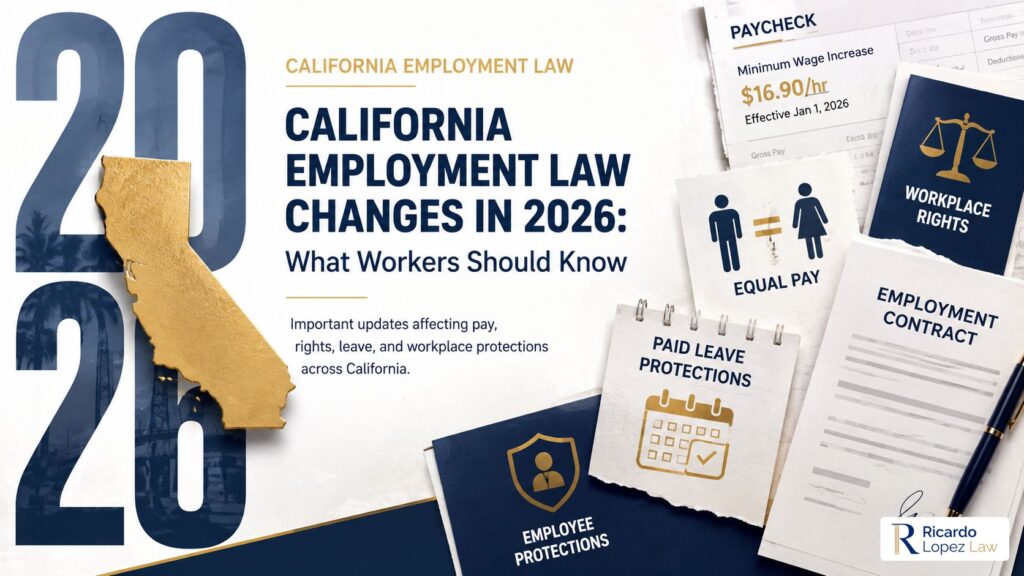
California workers entered 2026 with several important changes involving minimum wage, pay equity, workplace-rights notices, paid sick leave, and employment contracts. Some of these laws create new employee rights, while others change deadlines or expand how existing protections work.
For employees in Long Beach and throughout California, the most useful approach is practical: know which rules changed, identify whether they apply to you, and keep the records that can prove what happened.
1. California Minimum Wage Increased to $16.90
California’s statewide minimum wage increased to $16.90 per hour on January 1, 2026, for employers of every size.
That figure is the general statewide floor. Covered fast-food employees, certain health care workers, and employees covered by local wage ordinances may be entitled to a higher rate.
Long Beach also has local wage rules for certain hotel and concessionaire workers. For qualifying workers in those categories, the applicable rate increased to $26.50 per hour on July 1, 2026.
The statewide increase also affects the general salary threshold for many executive, administrative, and professional exemptions. In 2026, that threshold is $70,304 per year, although salary alone does not determine exempt status.
2. SB 294 Created the Workplace Know Your Rights Act
The Workplace Know Your Rights Act, enacted through SB 294, took effect January 1, 2026.
Employers must provide current employees with a stand-alone written notice of specified workplace rights by February 1, 2026, and annually thereafter. The notice is delivered through a method the employer normally uses for employment-related information.
The Labor Commissioner explains that the notice covers categories including:
- Protection from retaliation
- Workers’ compensation rights
- Protections against unfair immigration-related practices
- Labor organizing and group activity rights
- Constitutional rights during certain workplace law-enforcement interactions
- Information about enforcement agencies
- Other workplace-rights information required by the statute
The law also includes an emergency-contact component. Employees must be allowed to designate a person to be contacted in circumstances covered by the law.
3. SB 642 Expanded California Equal Pay Act Protections
California’s Equal Pay Act already prohibited certain pay disparities for substantially similar work, subject to statutory defenses. SB 642 made important changes effective January 1, 2026.
Among other updates, the law now provides that a civil action to recover wages under the covered equal-pay provisions may be filed no later than three years after the last date the cause of action occurs.
It also allows an employee to seek relief for the period in which the violation existed, up to six years, subject to the statute’s requirements.
The 2026 law further clarifies when a cause of action occurs, including when an unlawful compensation decision or practice is adopted, when a worker becomes subject to it, or when the worker is affected by its application, including through compensation payments.
What workers should save
If you suspect unequal pay, keep lawful copies of:
- Offer letters
- Pay stubs
- Compensation plans
- Job descriptions
- Performance reviews
- Promotion or raise communications
- Job postings showing pay ranges
Do not access confidential salary files or personnel records you are not authorized to view.
4. Paid Sick Leave Uses Expanded for Certain Crime-Related Proceedings
California paid sick leave can be used for more than an employee’s own illness.
Under the 2026 changes reflected in Labor Code section 246.5 and related Government Code protections, paid sick leave may be available for certain employees who need time off to attend specified judicial proceedings when the employee or a qualifying family member is a victim of a covered crime.
The law identifies proceedings that can include matters such as post-arrest release decisions, pleas, sentencing, post-conviction release decisions, delinquency proceedings, or other proceedings where a covered person’s right is at issue.
The exact right to leave depends on the employee’s circumstances and the statutes involved, so workers should avoid assuming every court appearance is automatically covered.
5. AB 692 Restricts Stay-or-Pay Employment Contracts
AB 692 applies to qualifying contracts entered into on or after January 1, 2026.
The law restricts contract terms that require a worker to pay an employer, training provider, or debt collector when the worker’s relationship with a particular employer ends. It also addresses terms that trigger collection activity or impose a penalty, fee, or cost because the work relationship terminates.
Examples specifically addressed in the statute include certain quit fees, retraining fees, replacement fees, immigration or visa-related reimbursement demands, liquidated damages, lost goodwill, and lost profit.
AB 692 includes exceptions for specified arrangements, such as certain government loan programs, qualifying tuition agreements for transferable credentials, approved apprenticeships, and carefully structured discretionary or unearned bonus agreements.
When a violation is established, Labor Code section 926 provides for actual damages or $5,000 per worker, whichever is greater, along with injunctive relief and reasonable attorney’s fees and costs.
What workers should do?
Keep any training repayment, tuition, bonus, or debt agreement you sign. If you receive a repayment demand, identify the date of the agreement and obtain advice before assuming the amount is enforceable.
6. Automated-Decision Rules Remain Important in Hiring and Employment
California’s Civil Rights Council regulations addressing automated-decision systems in employment became effective on October 1, 2025. They remain highly relevant in 2026 as employers increasingly use automated tools in recruiting, screening, performance decisions, and other employment processes.
The regulations clarify that California anti-discrimination law can apply when automated systems harm applicants or employees based on protected characteristics. They also address employment-record retention involving automated-decision data.
These rules should not simply be described as a brand-new January 2026 law. Their effective date matters when preparing an accurate annual update.
Important Employment Protections That Did Not Start in 2026
California has long-standing protections involving:
- Overtime for non-exempt employees
- Meal and rest periods
- Protection against workplace discrimination and harassment
- Retaliation for certain protected complaints or activities
- Family and medical leave in qualifying circumstances
- Final wage requirements
- Restrictions on unlawful wage deductions
What to Do if You Think Your Employer Violated a 2026 Law
Start by preserving evidence rather than relying only on memory.
Useful records may include:
- Pay stubs and time records.
- Work schedules.
- The Workplace Know Your Rights notice.
- Handbook pages and written policies.
- Emails, texts, or messages about complaints and discipline.
- Offer letters, job postings, and compensation plans.
- Training, tuition, bonus, or repayment agreements.
- Written leave requests and employer responses.
Write down dates, names, and events while the details are fresh. If you are considering a complaint, claim, or lawsuit, get advice promptly because deadlines vary by statute.
Frequently Asked Questions
The statewide minimum wage is $16.90 per hour beginning January 1, 2026, unless a higher local or industry-specific rate applies.
The general minimum salary threshold for many executive, administrative, and professional exemptions is $70,304 per year. The employee must also satisfy the applicable duties test.
SB 294 requires California employers to give current employees a stand-alone annual notice explaining specified workplace rights. The first notice was due by February 1, 2026.
SB 642 expanded the filing period for covered wage-recovery claims to three years after the last date the cause of action occurs and allows relief for up to six years of a qualifying violation.
Yes, in specified circumstances involving an employee or qualifying family member who is a victim of a covered crime. The type of proceeding and other statutory requirements matter.
Not all of them. AB 692 prohibits many termination-triggered stay-or-pay terms in contracts entered into on or after January 1, 2026, but the law contains several exceptions.
The main Civil Rights Council automated-decision employment regulations became effective October 1, 2025, and remain important in 2026.
Final Takeaway
The biggest California employment-law changes in 2026 are not all about one type of claim. They affect pay, employee notices, equal-pay deadlines, leave rights, and contracts that can restrict worker mobility.
For workers, the best response is to verify the rule that applies to your specific job, keep your employment records, and act promptly when something looks wrong. A California employment attorney can help determine which law applies, what evidence matters, and which deadline controls.
Social Share

Ricardo López
Ricardo López is the founder and lead attorney at Ricardo Lopez Law, where he is committed to providing strong, compassionate legal representation. With a deep understanding of the law and a tireless dedication to justice, Ricardo works closely with clients to guide them through challenging legal situations. On the blog, he shares valuable legal tips, insights, and updates to help individuals make informed decisions and protect their rights.
Practice areas
Client Reviews
"I want to thank Ricardo Lopez and the attorneys at Ricardo Lopez Law for helping me with my employment case. Mr. Lopez was compassionate, patient, and I always felt that I was in good hands. I definitely recommend Ricardo Lopez."
Maria C.
"Ricardo Lopez is a very effective and efficient attorney. He fights for workers’ rights, and he will not rest until you receive justice. I am thrilled with my settlement!"
Jesus M.
"Ricardo is an amazing attorney. He was efficient and was able to resolve my case within 7 months. I was very happy with the result, and I can’t thank him enough for his hard work!"
Lucia M.
"If you’re looking for legal representation, Ricardo Lopez is the attorney you should hire. Mr. Lopez was very responsive, confident, and knowledgeable. He makes sure you understand your options and keeps you informed. He obtained the policy limits for my case, and I couldn’t be happier!"
Danielle M.
"Ricardo Lopez is an excellent attorney! My case was resolved in a short period of time. He is truly the best attorney out there. Thanks to him I won my case."
Blanca H.
"Mr. Lopez provided excellent, top-notch services. He is very professional, welcoming, and knowledgeable."