
California Minimum Wage 2026: What Long Beach Workers Need to Know
Table of Contents
Toggle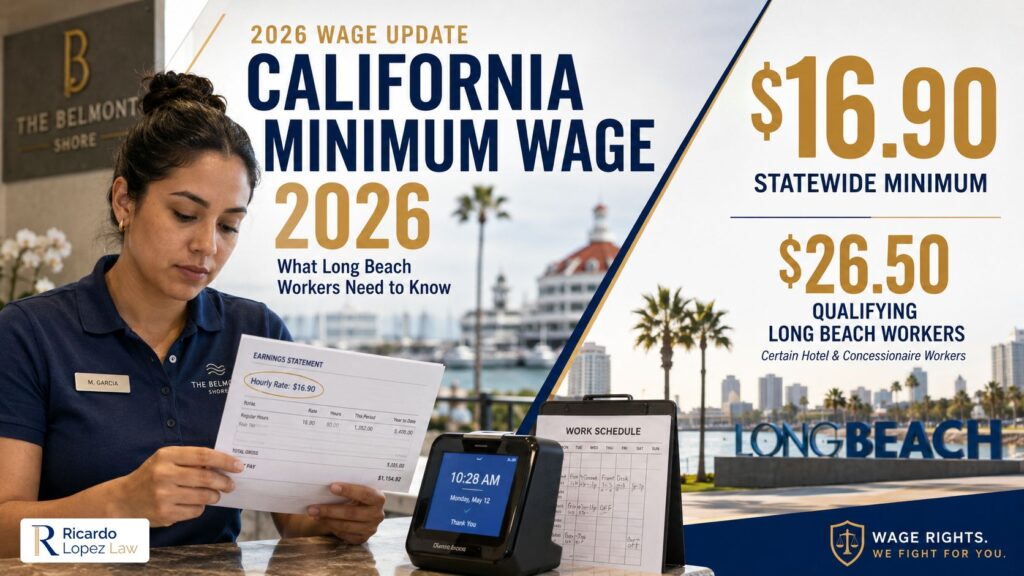
California’s minimum wage increased again in 2026, but the statewide rate is only the starting point for many workers. Employees in Long Beach may be covered by the general California minimum wage, a higher industry-specific rule, or a local wage requirement for certain hotel and concessionaire jobs.
This guide explains the 2026 California minimum wage, the Long Beach rules that may affect local workers, how tips and off-the-clock work are treated, and what records can help if you believe you were underpaid.
California’s Statewide Minimum Wage in 2026
Effective January 1, 2026, California’s statewide minimum wage is $16.90 per hour for employers of every size.
That rate generally applies unless a worker is covered by a higher local or industry-specific minimum wage. California’s Department of Industrial Relations specifically notes that covered fast-food workers and certain health care workers are subject to higher minimum wage rules.
Minimum wage law is not limited to the hourly rate printed on a pay stub. Employers generally must pay employees for compensable time worked. Problems can arise when required tasks are performed before clocking in, after clocking out, during an automatically deducted meal period, or through work-related calls and messages outside scheduled hours.
Long Beach Workers May Have Higher Local Rates
Long Beach has special wage rules for certain workers. These rules do not apply to every employee in the city, so job location and employer coverage matter.
Long Beach Hotel Workers
Qualifying hotel workers in Long Beach are covered by a city-specific wage ordinance. The local hotel-worker rate was $25.00 per hour beginning July 1, 2025. Under the city’s approved schedule, it increased to $26.50 per hour on July 1, 2026.
A worker should not assume that every hotel-related job automatically qualifies. Coverage depends on the ordinance’s definitions and the employer or workplace involved.
Long Beach Concessionaire Workers
Long Beach also has a local living-wage requirement for qualifying concessionaire workers at covered locations. The City issued a 2026 notice setting the covered concessionaire-worker rate at $26.50 per hour effective July 1, 2026.
Because local wage rules are specific, workers should confirm whether their employer and position fall within the applicable ordinance rather than comparing pay only to the statewide rate.
Industry-Specific Minimum Wages Can Also Apply
Covered fast-food restaurant employees have a higher minimum wage than the general state rate under California’s fast-food law. Certain health care workers also have a separate minimum-wage schedule that varies depending on the type of covered facility and other statutory factors.
Tips Cannot Be Used to Reduce the California Minimum Wage.
California does not allow employers to use a tip credit to satisfy minimum wage obligations.
A server, bartender, salon employee, or other tipped worker must receive the legally required minimum wage from the employer in addition to tips left by customers. An employer cannot lawfully reduce the required base wage simply because an employee receives tips.
Tip pooling and tip distribution can involve separate rules, but the basic point is straightforward: customer tips do not replace the employer’s obligation to pay the applicable minimum wage.
Common Minimum Wage and Wage-Theft Problems
Underpayment does not always look like an obvious hourly rate below the legal minimum. Wage problems often come from timekeeping, deductions, or classification practices.
Examples can include:
- Requiring setup, cleanup, security checks, changing time, or closing work off the clock when the time is compensable.
- Asking employees to answer work calls, texts, or messages without recording the time.
- Automatically deducting meal periods even when employees continue working.
- Failing to pay the higher wage required by a local or industry-specific rule.
- Making deductions that unlawfully shift business costs or losses to employees.
- Treating a worker as exempt or as an independent contractor when the legal requirements are not met.
How to Check Whether Your Pay Is Correct
Start with records you already have. Compare your pay stubs with your own understanding of the hours and work performed.
Review:
- Hourly rate: Is the rate at least the correct state, local, or industry minimum?
- Regular hours: Do the hours on the wage statement match your actual work time?
- Overtime: If you are non-exempt, check whether overtime was properly recorded and paid.
- Meal periods: Look for automatic deductions when you actually worked through a meal period.
- Deductions: Identify deductions you do not recognize or that appear connected to uniforms, shortages, tools, or other business expenses.
- Tips: Confirm that tips were not used to reduce your employer-paid minimum wage.
For example, an employee paid $16.50 per hour after January 1, 2026 would be below the general statewide minimum wage unless a lawful exception applies. A qualifying Long Beach hotel worker paid $25.00 per hour after July 1, 2026 would also need to check the city’s higher $26.50 hotel-worker rate.
Records That Can Help Support a Wage Claim
Keep lawful copies of records available to you, including:
- Pay stubs and wage statements
- Timecards or timekeeping screenshots
- Work schedules
- Offer letters and compensation agreements
- Texts or emails about work performed outside scheduled hours
- Records of missed or interrupted meal and rest periods
- Policies concerning tips, deductions, or timekeeping
Do not alter employer records, access restricted systems without authorization, or take confidential information you are not entitled to possess.
What Remedies May Be Available for Minimum Wage Violations?
The available remedy depends on the facts and the type of violation. A worker may be able to seek unpaid wages and other relief allowed by California law. Minimum-wage violations may also involve liquidated damages in qualifying circumstances. Separate penalties or remedies can arise from unlawful deductions, inaccurate wage statements, missed breaks, or unpaid final wages.
The California Labor Commissioner accepts wage claims. Its guidance states that wage claims involving minimum wage, overtime, unpaid meal or rest breaks, sick leave, illegal deductions, or unpaid reimbursements generally should be filed within three years. Different deadlines can apply to different legal theories, so workers should not wait until the end of a limitation period to get advice.
Frequently Asked Questions
The statewide minimum wage is $16.90 per hour beginning January 1, 2026, unless a higher local or industry-specific minimum wage applies.
For workers covered only by the general statewide rule, the rate is $16.90 per hour. Qualifying Long Beach hotel workers and qualifying concessionaire workers have higher local rates, including $26.50 per hour effective July 1, 2026 for covered workers.
No. California does not permit a tip credit. The employer must pay the applicable minimum wage separately from tips.
If the time is legally compensable work time, it generally must be paid even if it occurs before the scheduled start or after the scheduled end of a shift.
Potentially, yes. Local coverage must first be confirmed. Keep pay and time records and obtain advice about the correct enforcement route.
The Labor Commissioner states that many claims involving minimum wage, overtime, meal and rest breaks, sick leave, illegal deductions, and reimbursements have a three-year filing period. Other claims may have different deadlines.
California law protects workers in many circumstances when they raise good-faith wage concerns or exercise protected labor rights. If discipline, reduced hours, threats, or termination follow a complaint, document the timeline and seek legal advice promptly.
Final Takeaway
The correct minimum wage for a Long Beach employee in 2026 may depend on more than one rule. The statewide floor is $16.90 per hour, while covered hotel and concessionaire workers in Long Beach may be entitled to substantially higher local rates. Industry-specific wage laws can also change the calculation.
Check your rate, verify all hours worked, keep your own lawful records, and do not assume the amount on a pay stub is correct simply because payroll issued it. If the numbers do not match the law, a California wage-and-hour attorney or the Labor Commissioner can help you evaluate the next step.
Social Share

Ricardo López
Ricardo López is the founder and lead attorney at Ricardo Lopez Law, where he is committed to providing strong, compassionate legal representation. With a deep understanding of the law and a tireless dedication to justice, Ricardo works closely with clients to guide them through challenging legal situations. On the blog, he shares valuable legal tips, insights, and updates to help individuals make informed decisions and protect their rights.
Practice areas
Client Reviews
"I want to thank Ricardo Lopez and the attorneys at Ricardo Lopez Law for helping me with my employment case. Mr. Lopez was compassionate, patient, and I always felt that I was in good hands. I definitely recommend Ricardo Lopez."
Maria C.
"Ricardo Lopez is a very effective and efficient attorney. He fights for workers’ rights, and he will not rest until you receive justice. I am thrilled with my settlement!"
Jesus M.
"Ricardo is an amazing attorney. He was efficient and was able to resolve my case within 7 months. I was very happy with the result, and I can’t thank him enough for his hard work!"
Lucia M.
"If you’re looking for legal representation, Ricardo Lopez is the attorney you should hire. Mr. Lopez was very responsive, confident, and knowledgeable. He makes sure you understand your options and keeps you informed. He obtained the policy limits for my case, and I couldn’t be happier!"
Danielle M.
"Ricardo Lopez is an excellent attorney! My case was resolved in a short period of time. He is truly the best attorney out there. Thanks to him I won my case."
Blanca H.
"Mr. Lopez provided excellent, top-notch services. He is very professional, welcoming, and knowledgeable."